By A Resident of 7th Avenue, Gaur City
A documented first-hand account of delayed registry, possession challenges, PMAY subsidy loss, lift concerns, community facility changes, and lessons for future homebuyers.
Disclaimer
This article reflects my personal experience as a homebuyer in 7th Avenue, Gaur City. The information presented is based on my Builder Buyer Agreement, payment records, builder communications, lender communications, resident correspondence, project brochures, photographs, and records maintained over several years.
This article is not intended to make legal conclusions regarding any company or individual. The purpose is to document my experience and provide information that may help future homebuyers conduct better due diligence before making a property purchase.
Table of Contents
- The Dream Begins
- About the Project
- Timeline of My Home Buying Journey
- Possession Delays
- Full Payment and No Dues Certificate
- Key Handover Without Registry
- The Registry Problem
- How Registry Delays Affect Homebuyers
- PMAY Subsidy Loss
- The Four Lifts That Became Two
- The Community Hall Question
- Resident Complaints and Protests
- Documentary Evidence
- Questions That Remain Unanswered
- Lessons for Future Buyers
- Advice for Buyers Considering New Gaursons Projects
- Frequently Asked Questions
- Final Thoughts
The Dream Begins
For most middle-class Indian families, buying a home is one of the biggest financial decisions of their lives.
It is not just a purchase. It represents years of savings, sacrifices, planning, and dreams.
When I booked an apartment in 7th Avenue, Gaur City during 2018, I believed I was making one of the safest investments for my family's future.
Like many buyers, I trusted the commitments made during the sales process, the project brochures, the Builder Buyer Agreement, and the reputation of the developer.
At that time, I imagined that by now I would simply be enjoying my home, focusing on my family, career, and future plans.
Instead, years later, I still find myself dealing with registry-related concerns, documentation issues, and questions that remain unresolved.
This article is not written out of anger.
It is written because I believe future homebuyers deserve access to the experiences of existing buyers before making one of the largest investments of their lives.
About the Project
| Project | 7th Avenue, Gaur City |
|---|---|
| Developer | Gaursons |
| Location | Greater Noida West |
| Booking Date | 31 May 2018 |
| Agreement Possession Date | 31 December 2019 |
| Current Situation | Registry pending despite full payment, stamp duty payment, and key handover |
Timeline of My Home Buying Journey
One of the easiest ways to understand my experience is through a timeline.
31 May 2018 - Apartment Booked
I booked my apartment in 7th Avenue with the expectation that the project would be delivered according to the commitments made by the builder.
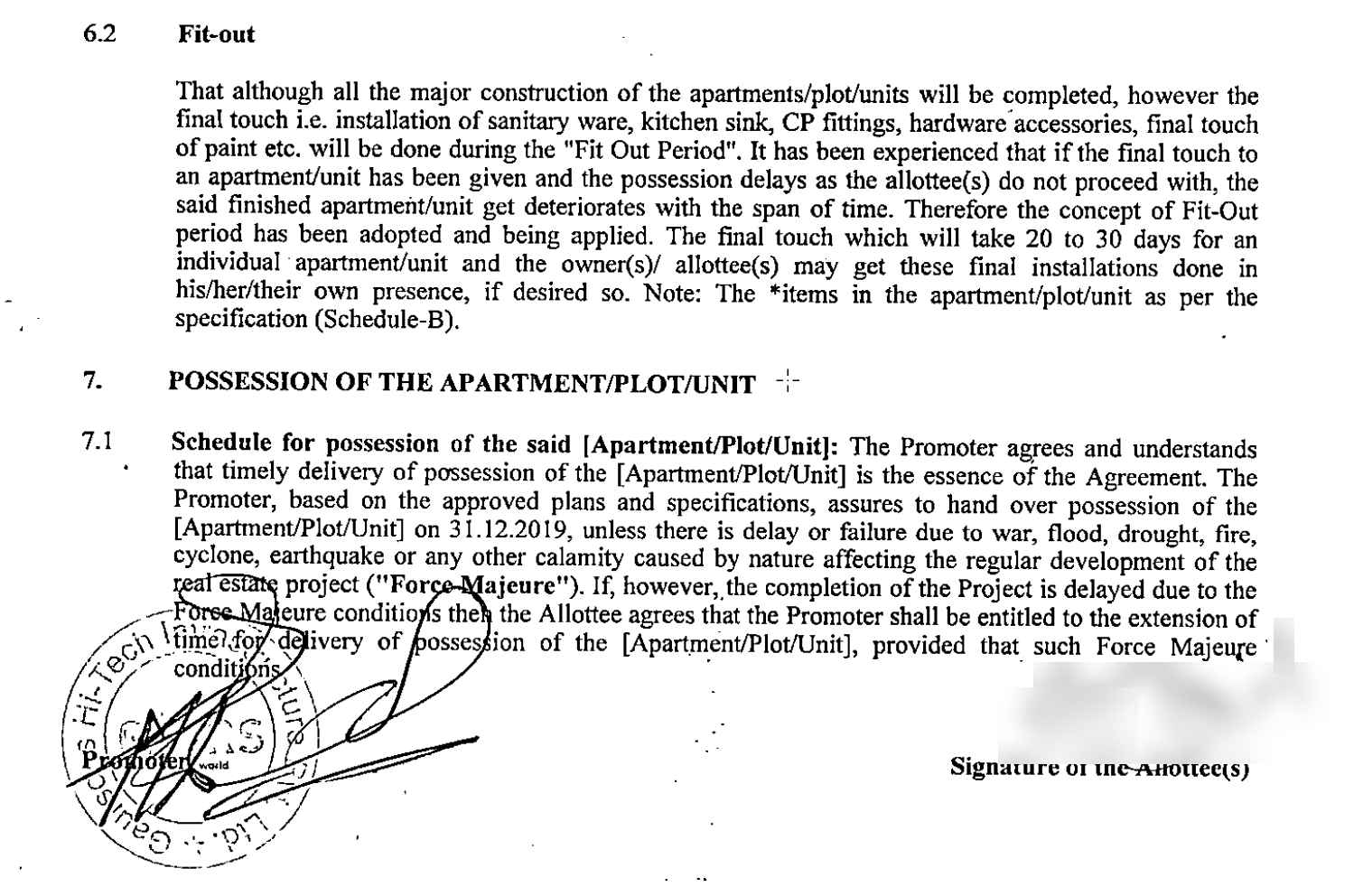
31 December 2019 - Possession Date Mentioned in Agreement
According to the Builder Buyer Agreement, possession was expected by 31 December 2019.
Like many buyers, I planned my finances and future expectations around this timeline.
As the date approached and eventually passed, I continued waiting for progress.
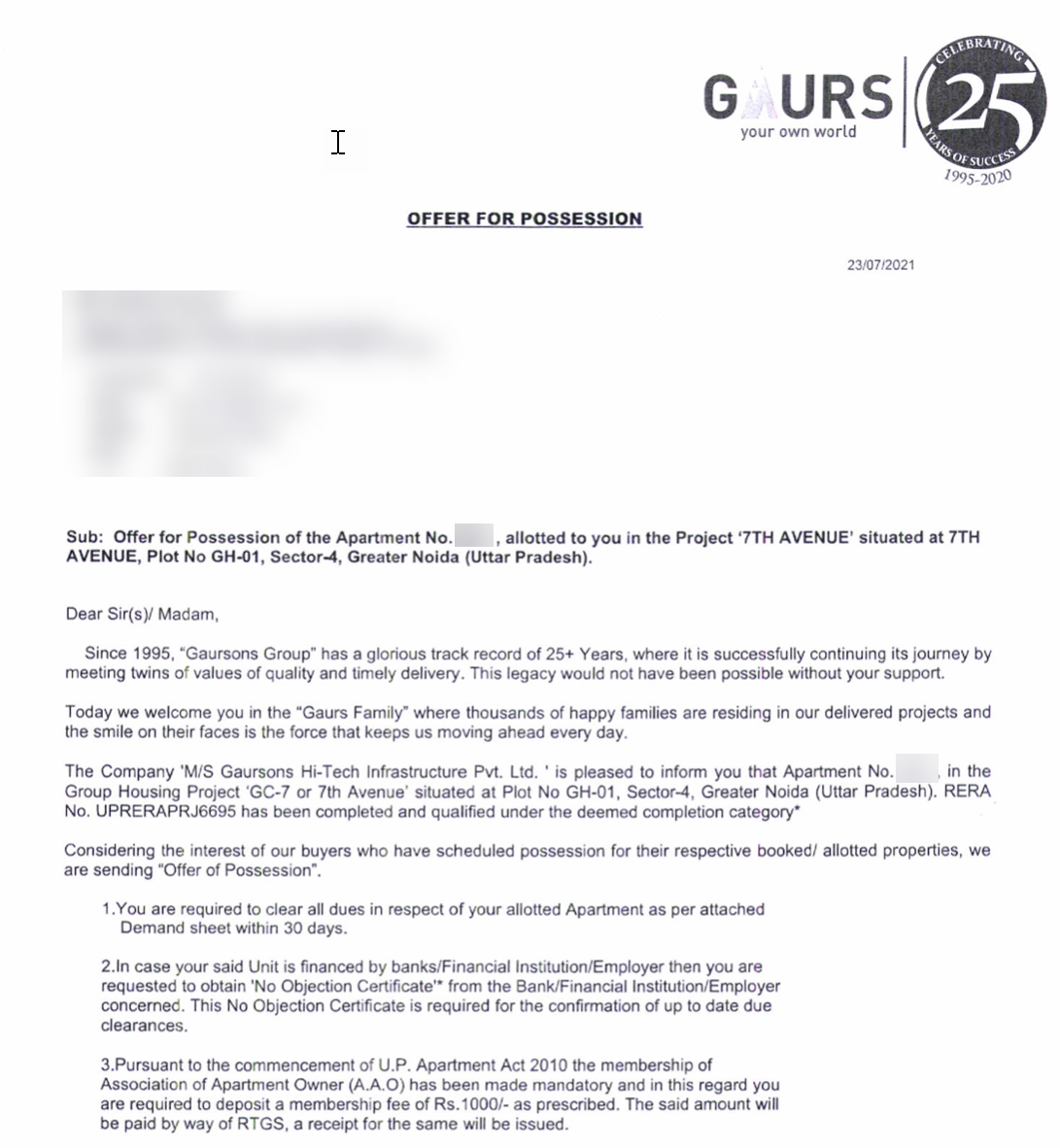
19 July 2021 - Offer of Possession and Final Demand
The builder issued an offer of possession and final demand.
At this stage, I believed the long wait was finally coming to an end.
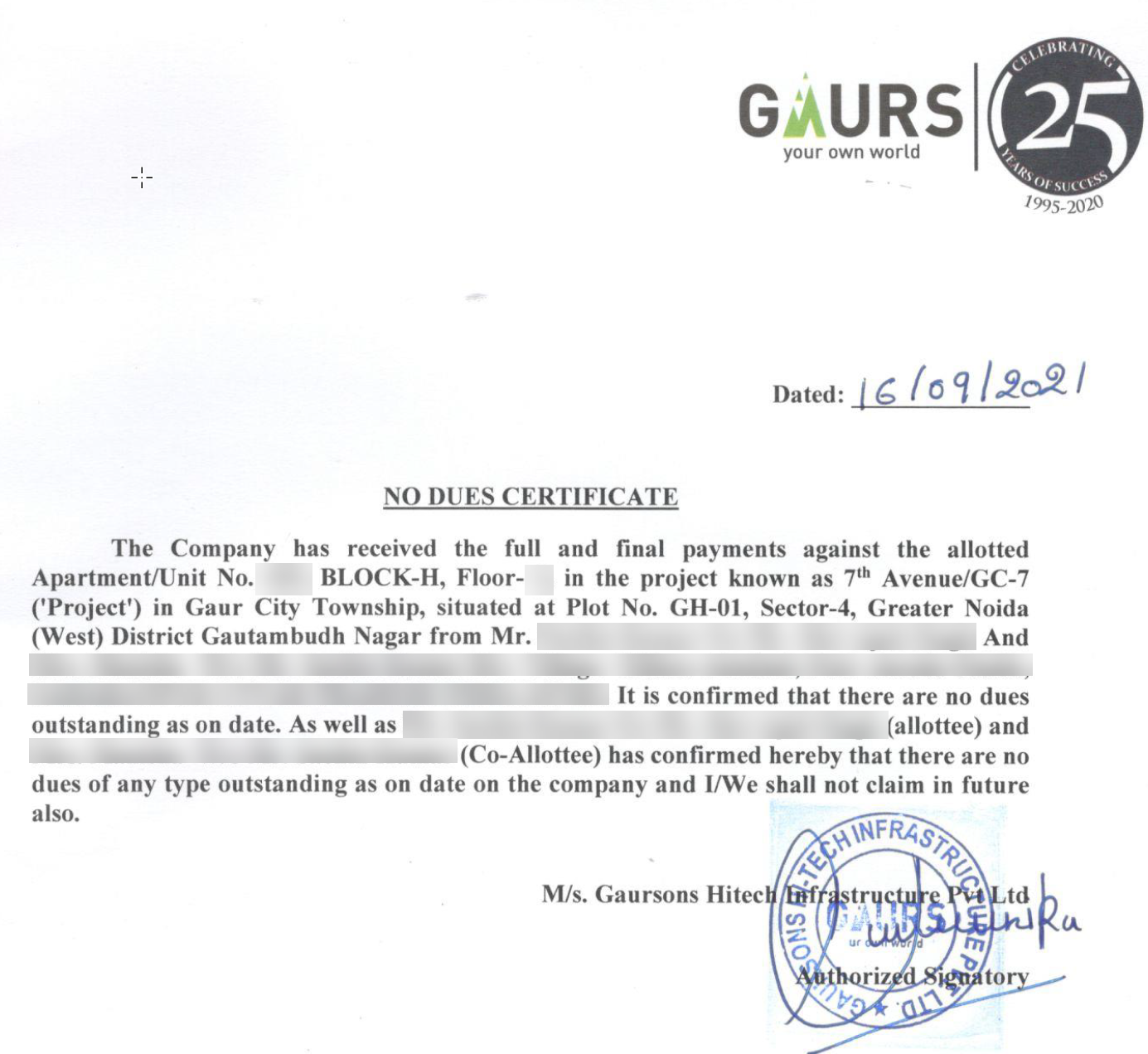
16 September 2021 - No Dues Certificate
After clearing all financial demands, I obtained a No Dues Certificate.
This should have represented the completion of my obligations as a buyer.
23 September 2021 - Stamp Duty Payment
I paid the stamp duty amount collected by the builder.
Like any buyer, I expected the remaining ownership formalities to move forward within a reasonable period.
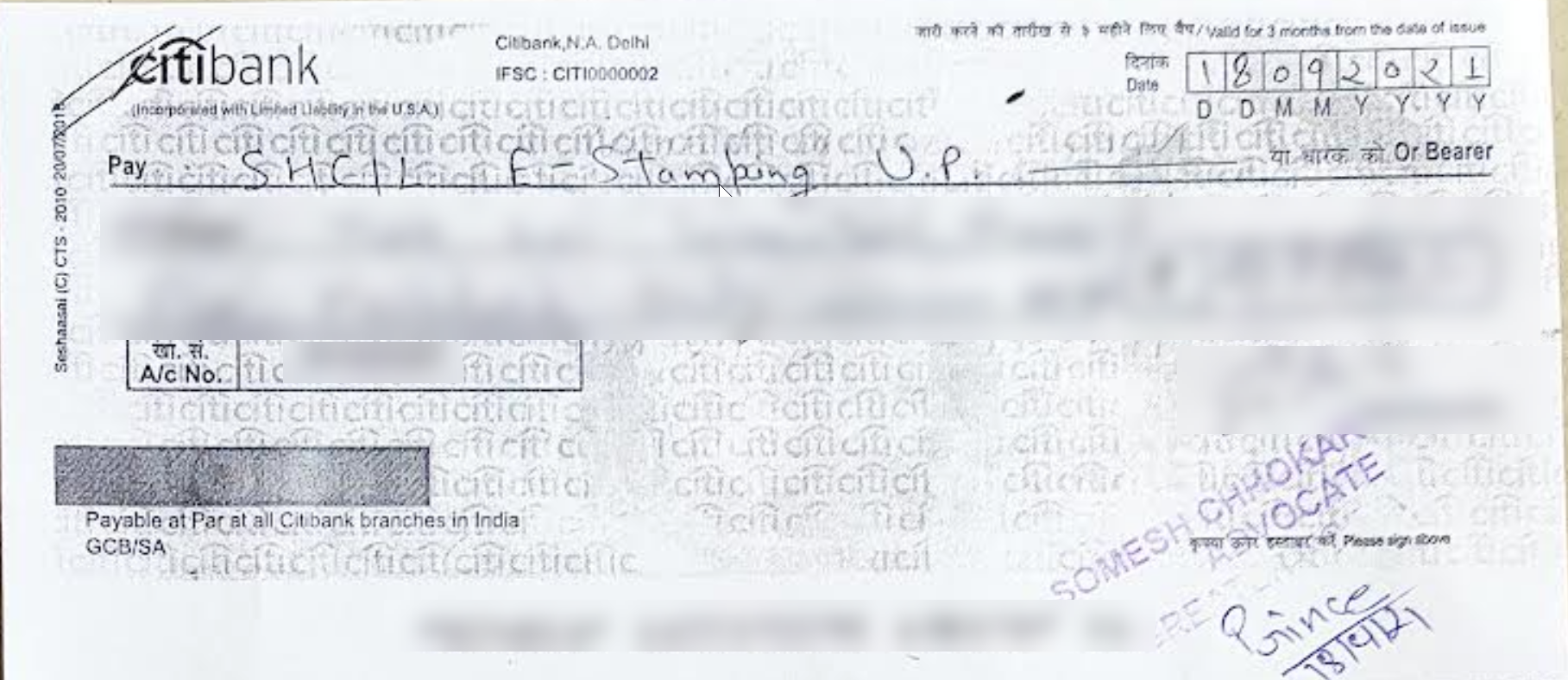
11 February 2022 - Key Handover
The builder handed over the keys.
Most people would assume that this marked the end of the journey.
Unfortunately, it did not.
The Registry Problem Nobody Prepared Me For
When most people buy a property, they focus on possession.
I did the same.
Like many first-time homebuyers, I assumed that once possession was offered, all remaining ownership formalities would naturally follow.
What I did not realize was how important the registry process would become.
Years after making payments, paying stamp duty, obtaining a No Dues Certificate, and receiving keys, the registry of my apartment remains pending.
Many people ask me:
If you already have the flat, why are you worried about registry?
The answer is simple.
Registry is one of the most important legal milestones in the homeownership process.
Without it, uncertainty remains.
For buyers, registry is not a technical formality. It is a critical ownership milestone.
The longer it remains unresolved, the longer buyers remain uncertain about the future.
Why Registry Matters
Many homebuyers may not fully appreciate the importance of registry until they face delays themselves.
Registry affects:
- Property ownership documentation
- Future resale opportunities
- Transfer of ownership
- Loan-related processes
- Legal certainty regarding ownership records
When registry remains pending for years, buyers are left waiting for a process that they expected to be completed long ago.
As a buyer who fulfilled every financial obligation, I naturally expected the remaining ownership process to move forward.
Instead, years later, I am still waiting.
Living in a Home While Ownership Questions Remain
One of the most difficult aspects of this experience is the unusual situation of having keys, making payments, paying maintenance, and living with the practical responsibilities of ownership while still waiting for registry.
From the outside, everything may appear complete.
Inside, however, important questions remain unresolved.
For years I have continued asking:
- When will registry finally happen?
- What is the definitive timeline?
- What obstacles remain?
- Why has the process taken so long?
These are not legal questions.
They are homeowner questions.
And homeowners deserve answers.
The Financial Cost of Waiting
When people discuss delayed projects, they often focus on construction timelines.
What receives much less attention is the financial impact on buyers.
For many families, purchasing a home is the largest investment they will ever make.
The consequences of delays do not disappear simply because possession is eventually offered.
Financial effects can continue for years.
In my case, those effects included:
- PMAY subsidy loss
- Registry-related uncertainty
- Reduced flexibility regarding sale of the property
- Continued maintenance expenses
- Ongoing banking and documentation concerns
Each issue by itself may appear manageable.
Combined over multiple years, they create significant financial and emotional pressure.
The PMAY Subsidy Loss
Among all financial consequences associated with my purchase, the PMAY subsidy loss remains one of the most frustrating.
Like many middle-class homebuyers, I qualified for benefits under the Pradhan Mantri Awas Yojana (PMAY).
The subsidy represented meaningful financial support for families purchasing their homes through loans.
For buyers, these benefits can reduce the overall financial burden significantly.
Unfortunately, I later received written communication from my lender informing me that the subsidy had been withdrawn.
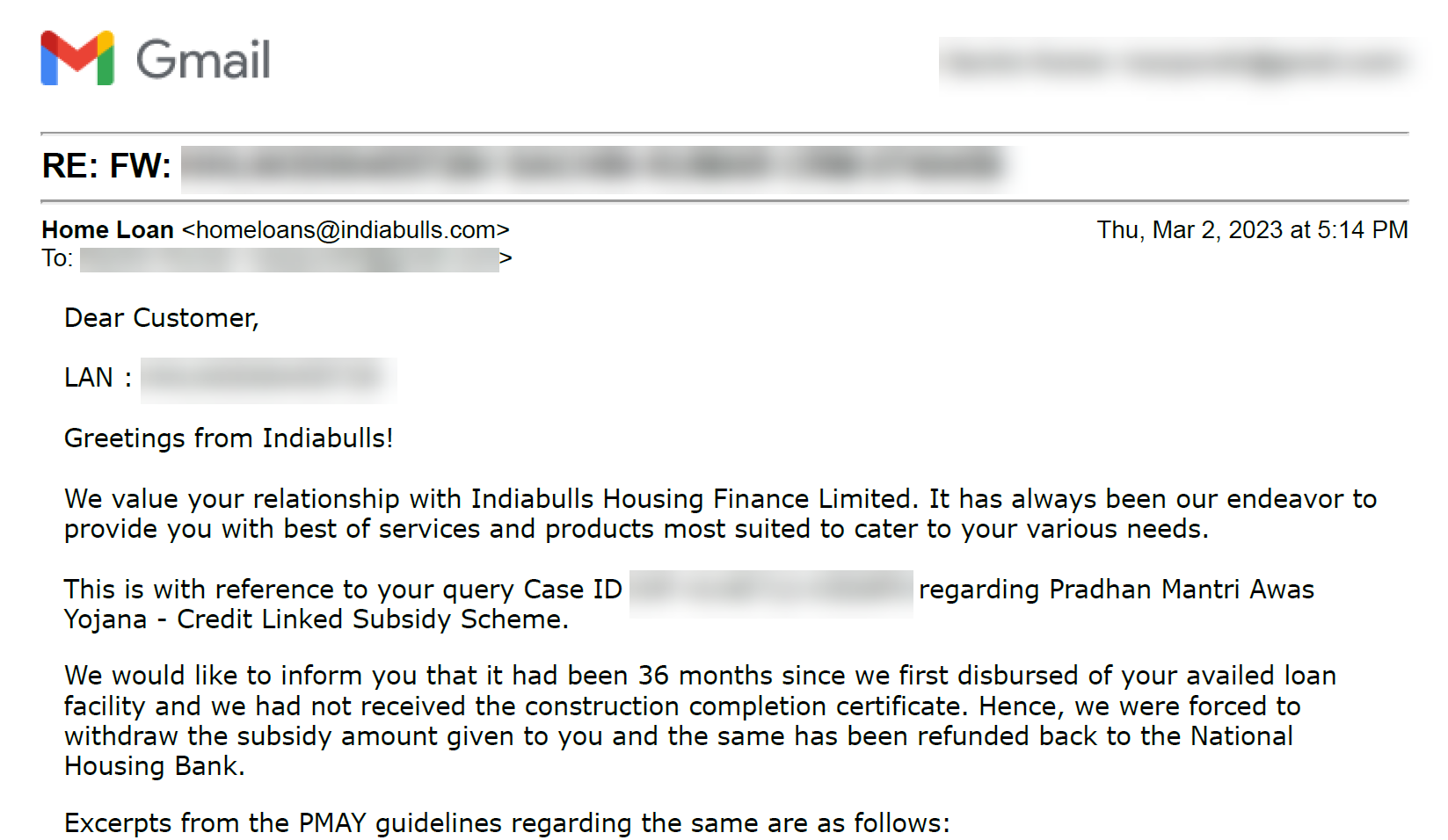
According to the lender's communication, required completion-related requirements were not fulfilled within the prescribed period.
As a result, the subsidy amount was returned.
The financial impact exceeded ₹2 lakh.
For some people, ₹2 lakh may appear to be just a number.
For a middle-class family, it represents:
- Years of savings
- Children's education expenses
- Emergency reserves
- Furniture and household setup costs
- Future investment opportunities
The loss was not merely financial.
It was also emotional because it represented a benefit that could not simply be recovered later.
Bank Calls and Continuous Follow-Ups
One aspect that rarely appears in property advertisements is the practical burden that unresolved ownership issues place on buyers.
Over the years, I have repeatedly found myself explaining the same situation to my lender.
The conversation often follows the same pattern:
Why is the registry still pending?
And my answer remains the same:
The registry has not yet been completed.
Explaining the same situation repeatedly over several years becomes exhausting.
It creates the feeling that a major chapter of life remains unfinished.
A home purchase should provide certainty.
Instead, unresolved matters continue generating new questions.
The Hidden Emotional Cost
Real estate delays are often discussed in terms of money.
The emotional impact receives far less attention.
In reality, the emotional cost can be equally significant.
When major ownership issues remain unresolved for years:
- Stress increases
- Future planning becomes difficult
- Family members become concerned
- Confidence in long-term plans decreases
A home is supposed to provide stability.
It is supposed to be a place where families feel secure.
Instead, prolonged uncertainty creates exactly the opposite feeling.
For me, this experience has involved years of follow-ups, waiting, documentation, unanswered questions, and uncertainty.
That burden is difficult to measure on a financial statement.
But every buyer who has experienced prolonged uncertainty understands how real it can be.
What Makes This Situation Particularly Frustrating
The most frustrating aspect is not the existence of a problem.
Problems can be solved.
Delays can happen.
Unexpected situations can arise.
The real challenge is the length of time involved.
When years pass after:
- Booking the apartment
- Making all payments
- Receiving a No Dues Certificate
- Paying stamp duty
- Receiving keys
buyers naturally expect closure.
That closure remains missing.
And that is why the registry issue continues to be one of the most important concerns for me and many other residents.
The Four Lifts That Became Two
Among all the concerns raised by residents over the years, one issue affects daily life more than almost any other.
The lifts.
For many people reading this article, the number of lifts in a residential tower may seem like a minor detail.
It is not.
When hundreds of people depend on those lifts every single day, lift capacity becomes a quality-of-life issue.
It affects office timings, school schedules, elderly residents, visitors, delivery personnel, domestic workers, and emergency situations.
In a high-rise residential tower, lift availability is not a luxury.
It is basic infrastructure.
What Residents Expected
According to documentation available with residents, Tower H was expected to have four lifts.
This expectation was not created by verbal discussions.
Residents relied on written project documentation and agreement provisions.
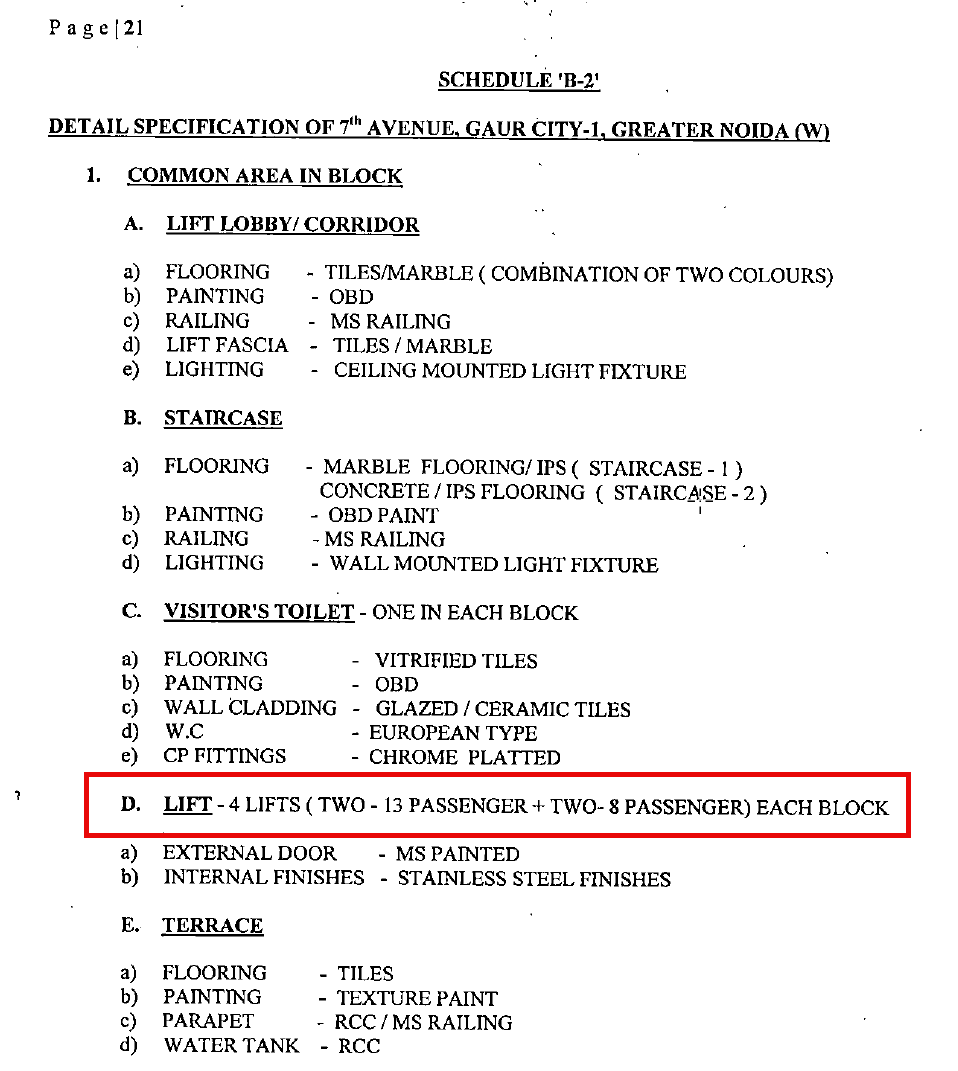
For buyers evaluating residential projects, infrastructure details such as lifts often influence purchasing decisions.
Particularly in high-rise buildings, residents naturally expect the delivered infrastructure to align with documented commitments.
What Residents Observed
Residents later observed that only two lifts were available.
The practical impact becomes easier to understand when considering the scale of the tower.
| Item | Approximate Value |
|---|---|
| Floors | 20+ |
| Apartments | Approximately 160 |
| Lifts Expected | 4 |
| Lifts Observed | 2 |
When only two lifts serve a large residential tower, congestion becomes inevitable.
During peak morning hours, residents may experience significant waiting times.
Parents trying to get children to school, professionals rushing to offices, and elderly residents all experience the consequences.
A Daily Problem, Not a One-Time Issue
What makes this issue particularly frustrating is that it affects residents every single day.
Registry delays may create periodic stress.
Lift shortages create daily inconvenience.
A resident does not need to think about legal documents to feel the impact.
The impact becomes visible every morning and every evening.
Waiting for elevators becomes part of the daily routine.
For elderly residents, the inconvenience can become even more significant.
For families with young children, it becomes another avoidable challenge in an already busy day.
Resident Complaints Regarding Lift Availability
This issue was not raised by a single buyer.
Multiple residents jointly communicated their concerns to the builder.
Emails were sent.
Documentation was shared.
Clarification was requested.
Residents specifically referenced the agreement documentation while seeking explanations.
The fact that numerous residents raised the same concern demonstrates that this was not viewed as an isolated issue.
It became a collective concern affecting an entire tower.
The Community Hall That Residents Expected
Amenities play an important role in residential projects.
Developers understand this.
Buyers understand this.
Amenities influence purchasing decisions because they affect everyday quality of life.
Families compare projects based on:
- Parks
- Community spaces
- Sports facilities
- Parking arrangements
- Common areas
- Social infrastructure
One such amenity in 7th Avenue was the community hall.
What Buyers Were Shown
According to project materials available with residents, a community hall formed part of the expected amenities.
For residential societies, community halls often serve important purposes.
- Resident meetings
- Cultural events
- Festivals
- Social gatherings
- Children's activities
- Community programs
Such facilities contribute to community life and are frequently highlighted during project marketing.
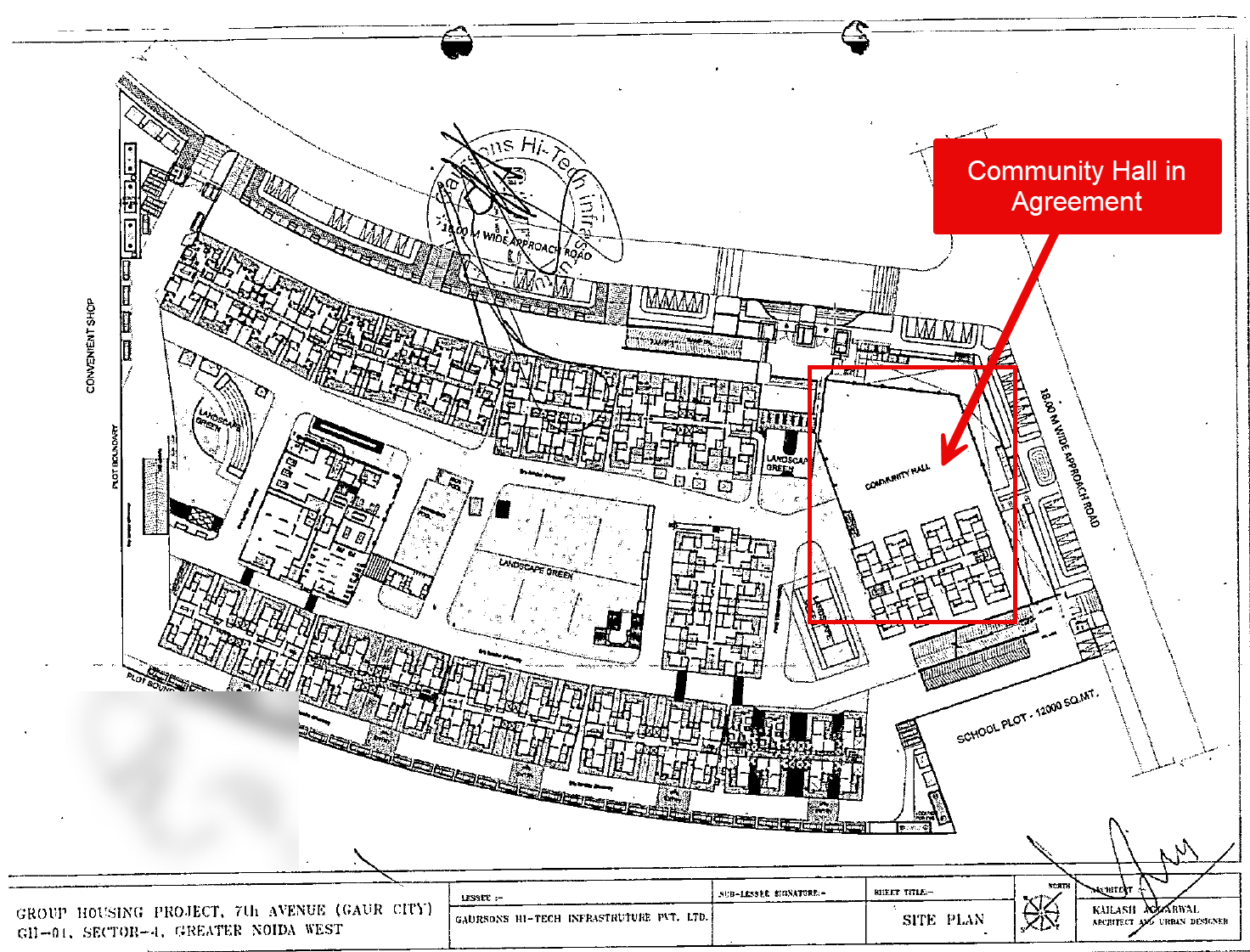
What Residents Later Observed
Residents later observed that the location associated with the community hall became a banquet facility known as:
The Venue by SK
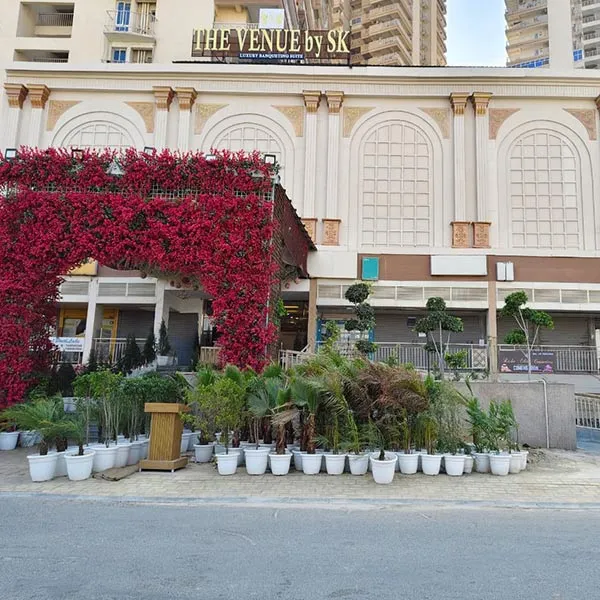
The concern raised by residents is straightforward.
A community hall intended for residents and a commercial banquet facility serve fundamentally different purposes.
As buyers, residents naturally ask:
- When did this change occur?
- Why did this change occur?
- Were buyers informed?
- How was the decision communicated?
These are reasonable questions because amenities often influence purchasing decisions.
Promised Expectations vs Resident Experience
| Expectation | Resident Experience |
|---|---|
| Possession by December 2019 | Delayed beyond agreement timeline |
| Registry after completion of formalities | Still pending in 2026 |
| Four lifts in H Tower | Residents observed two lifts |
| Community hall amenity | Residents observed banquet facility |
| Smooth homeownership journey | Years of follow-ups and uncertainty |
The purpose of this comparison is not to draw conclusions.
It is simply to illustrate why many residents continue raising questions years after purchasing their homes.
Other Concerns Raised by Residents
Over time, residents have also discussed concerns regarding:
- Maintenance quality
- Pending amenities
- Common area upkeep
- Dust from ongoing construction activities
- Parking-related issues
- Community facility access
Individual residents may have different experiences.
However, these topics frequently appear in resident discussions and communications.
For prospective buyers evaluating any project, listening to existing residents often provides insights that brochures and sales presentations cannot.
Why These Issues Matter to Future Buyers
Some readers may wonder why I am discussing lifts and community facilities in an article that began with registry concerns.
The answer is simple.
Buying a home is not merely about acquiring four walls.
It is about purchasing an entire living experience.
Infrastructure, amenities, documentation, maintenance, and transparency all contribute to that experience.
When expectations and reality differ, buyers naturally want explanations.
That is why these issues continue to matter years after purchase.
Gaursons Review: My Personal Experience as a Buyer
Whenever people search online for terms such as:
- Gaursons review
- Gaur City review
- 7th Avenue review
- Gaursons complaints
- Gaur City resident experience
- Registry delay in Gaur City
they are usually looking for one thing:
The experience of actual buyers.
Not advertisements.
Not brochures.
Not marketing campaigns.
Real experiences.
As someone who booked a home in 2018 and is still dealing with unresolved issues years later, my experience can be summarized in one sentence:
The purchase process was easy. The ownership journey became unexpectedly long and complicated.
The initial booking process was smooth.
The sales process was professional.
The project appeared attractive.
The real challenges began after booking.
The longer the journey continued, the more questions emerged.
Possession timelines.
Registry timelines.
Amenities.
Documentation.
Follow-ups.
Clarifications.
Years later, many of those questions remain unanswered.
Documentary Evidence Supporting This Article
One reason I decided to write this article is because my observations are not based solely on memory.
Over the years, I preserved documents, emails, payment records, lender communications, and project materials.
As a result, much of this article can be traced back to documentary evidence.
The records maintained include:
- Builder Buyer Agreement
- Booking records
- Possession offer letter
- No Dues Certificate
- Stamp duty payment records
- Key handover documentation
- PMAY subsidy communication
- Registry-related correspondence
- Resident complaint emails
- Project brochures
- Resident photographs
- Protest documentation
This documentation is important because it allows discussions to focus on facts, timelines, and records rather than assumptions.
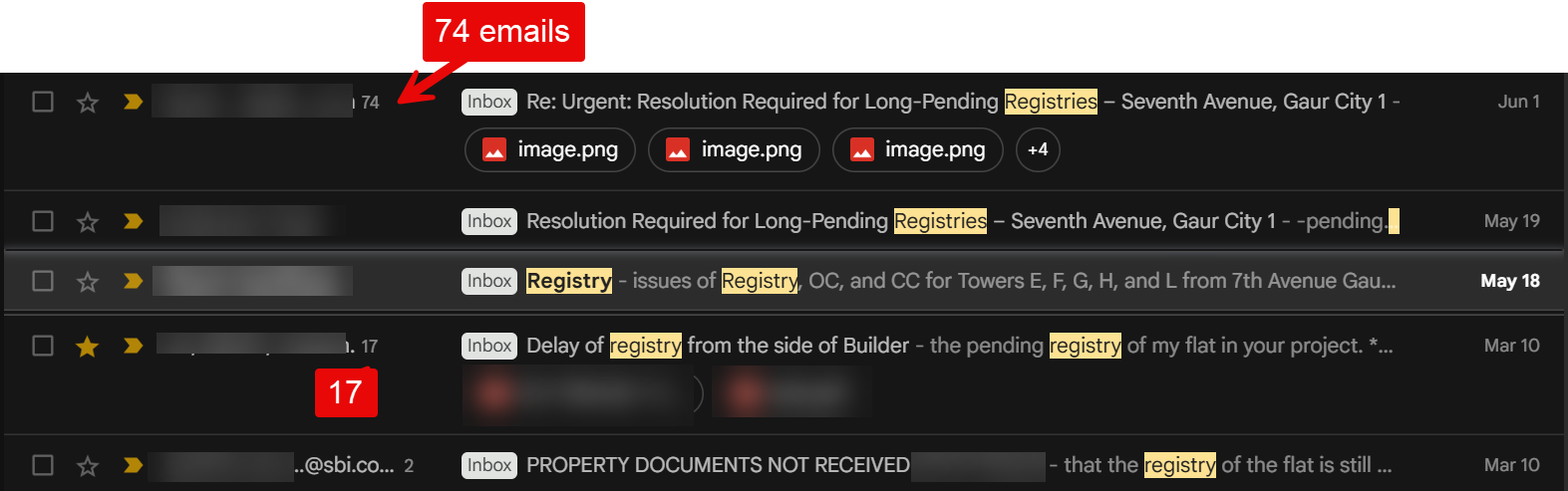
Years of Emails and Follow-Ups
One of the most exhausting aspects of this experience has been the volume of follow-up required.
Buying a home should not require years of reminders.
Yet over time, many residents found themselves repeatedly asking for updates regarding:
- Registry timelines
- Completion-related documentation
- Occupancy-related questions
- Amenities
- Lift concerns
- Pending facilities
Numerous emails were sent.
Multiple reminders were issued.
Questions were repeatedly raised.
Clarifications were requested.
In many cases, residents simply wanted written answers and clear timelines.
The longer these issues remained unresolved, the more frustration naturally accumulated.
When Individual Concerns Become Community Concerns
Every residential project experiences occasional complaints.
That is normal.
What makes a situation different is when similar concerns are raised repeatedly by large numbers of residents.
Over time, concerns regarding registry and project-related matters were discussed not only by individual buyers but also collectively by residents.
The reason is simple.
Many residents experienced similar uncertainties.
As concerns became more widespread, buyers increasingly sought collective solutions.
People began sharing information.
Comparing timelines.
Comparing communications.
Discussing documentation.
Attempting to understand why certain issues remained unresolved.
Resident Meetings, Representations and Protests
As years passed, some residents felt that additional efforts were required to bring attention to pending concerns.
Meetings were organized.
Collective representations were prepared.
Resident groups discussed possible approaches.
Public demonstrations and protests were also organized by residents seeking resolution of pending issues.
The purpose of these activities was straightforward:
Residents wanted answers.
Residents wanted timelines.
Residents wanted clarity.
Most importantly, residents wanted progress.
The Cost of Uncertainty
One theme appears repeatedly throughout this story.
Uncertainty.
Homebuyers can often tolerate delays when they have clear information.
People can plan around known timelines.
What becomes difficult is uncertainty without clear closure.
Uncertainty affects:
- Financial planning
- Property decisions
- Family decisions
- Investment planning
- Long-term confidence
Over time, uncertainty itself becomes a burden.
And that burden grows heavier with each passing year.
Questions That Still Remain Unanswered
Years after booking my apartment, several questions continue to remain unresolved.
These questions are not accusations.
They are simply questions that many buyers would naturally ask.
- Why is registry still pending years after full payment, stamp duty payment, and key handover?
- What is the definitive written timeline for completion?
- What specific obstacles remain today?
- Why were buyers required to wait so long after fulfilling their financial obligations?
- Why do certain delivered amenities appear different from resident expectations?
- Why have residents needed years of follow-up to obtain clarity regarding these issues?
These questions remain central to my experience as a homebuyer.
If I Could Go Back to 2018
If I could travel back in time and advise my younger self before booking the apartment, I would do several things differently.
Not because I regret buying a home.
But because I now understand the importance of due diligence in a way I did not understand then.
I would ask more questions.
I would request more documentation.
I would speak with more existing residents.
I would verify more commitments independently.
Most importantly, I would treat registry as seriously as possession.
That lesson alone could save future buyers years of frustration.
Lessons Every Homebuyer Should Learn Before Purchasing a Flat
One of the reasons I decided to publish this experience is because I hope future buyers can avoid some of the challenges that many residents have faced.
Real estate is one of the few purchases where a mistake can affect a family for decades.
Unlike buying a phone or a car, a property purchase often involves:
- Life savings
- Long-term loans
- Financial commitments spanning 15–30 years
- Family planning decisions
- Future investment goals
That is why due diligence is so important.
Lesson #1: Never Rely Solely on Sales Presentations
Sales presentations are designed to highlight the strengths of a project.
That is understandable.
However, buyers should never make decisions based solely on:
- Brochures
- Advertisements
- Marketing videos
- Sample flats
- Sales promises
Always verify important information independently.
The more expensive the purchase, the more verification is required.
Lesson #2: Speak to Existing Residents
This is perhaps the most important lesson I learned.
Before booking any property, speak directly with residents of the builder's existing projects.
Ask them:
- Was possession delivered on time?
- Was registry completed smoothly?
- Were promised amenities delivered?
- How responsive is the builder after possession?
- What unresolved issues remain?
Residents often provide insights that cannot be found in advertisements.
In many cases, a one-hour conversation with residents can save years of future frustration.
Lesson #3: Treat Registry as Seriously as Possession
When I booked my apartment, I focused heavily on possession timelines.
Looking back, I now realize that registry deserves equal attention.
Future buyers should ask:
- What is the registry process?
- What approvals are required?
- What dependencies exist?
- What is the expected timeline?
- Have previous phases completed registry successfully?
These questions may seem unnecessary during booking.
Years later, they become extremely important.
Lesson #4: Keep Every Document
One reason I can write this article today is because I preserved records.
Every buyer should maintain copies of:
- Builder Buyer Agreement
- Receipts
- Emails
- Letters
- Screenshots
- Payment proofs
- Project brochures
- Possession documents
- Registry communications
Documentation creates clarity.
Without records, buyers often struggle to reconstruct timelines years later.
Lesson #5: Compare Promises Against Delivery
Many buyers stop evaluating a project after possession.
In reality, evaluation should continue until all commitments have been fulfilled.
Questions worth asking include:
- Were all promised amenities delivered?
- Do common facilities match project representations?
- Have all ownership-related processes been completed?
- Are residents satisfied with the delivered outcome?
A project should ultimately be judged by what residents receive, not only by what was advertised.
Should You Buy a Gaursons Property?
This is a question many readers may ask after reading this article.
I cannot answer that question for anyone else.
Every buyer has different priorities, budgets, risk tolerance, and expectations.
However, I can share what I would do if I were evaluating a new project today.
Before making a booking decision, I would:
- Visit multiple completed projects by the builder.
- Speak directly with residents.
- Review registry status in completed phases.
- Verify amenities physically.
- Study resident forums and groups.
- Review project approvals.
- Compare promises with delivered reality.
Only after completing those steps would I make a final decision.
A home purchase deserves that level of investigation.
Advice for Buyers Considering Gaur Chrysalis or Future Gaursons Projects
If you are evaluating projects such as Gaur Chrysalis or other upcoming Gaursons developments, I strongly encourage independent due diligence.
That does not mean relying on online reviews alone.
It means conducting real-world verification.
I would personally recommend:
- Visiting existing Gaursons projects.
- Speaking with residents from older phases.
- Understanding registry status in delivered projects.
- Comparing delivered amenities against brochures.
- Reviewing unresolved resident concerns.
- Asking detailed questions regarding ownership documentation.
The objective is not to confirm a positive or negative opinion.
The objective is to make an informed decision.
Informed decisions are always better than decisions based solely on marketing material.
Frequently Asked Questions (FAQ)
Is registry completed for all flats in 7th Avenue?
Prospective buyers should verify the latest registry status directly with residents, the builder, and relevant authorities, as situations can change over time.
Why is registry important if possession has already been given?
Registry is a key ownership milestone that affects future transactions, ownership records, and various legal and financial processes.
What issues have some residents discussed in 7th Avenue?
Residents have discussed topics including registry delays, lift availability, amenities, maintenance concerns, and ownership-related documentation.
Why did the PMAY subsidy become an issue?
According to communication received from the lender, the subsidy was withdrawn because required completion-related requirements were not fulfilled within the prescribed timeframe.
Should buyers visit completed projects before investing in a new launch?
Yes.
Speaking directly with existing residents is one of the best ways to understand real-world project performance.
What is the most important lesson from this experience?
Treat registry, approvals, and delivered amenities with the same importance as possession.
Many buyers focus primarily on possession timelines and only later discover the importance of other aspects of ownership.
Why I Finally Decided to Publish This Story
For years, I kept hoping that all pending matters would eventually be resolved and that there would be no need to publicly discuss my experience.
Like most homebuyers, I wanted a simple outcome.
Buy the home.
Complete the paperwork.
Move on with life.
Unfortunately, the reality turned out to be very different.
As the years passed, I realized that many buyers were experiencing similar frustrations.
The same questions kept appearing:
- What is the registry status?
- When will pending issues be resolved?
- What happened to promised facilities?
- Why are residents still waiting?
I eventually concluded that future buyers deserve access to real buyer experiences before making major financial decisions.
That is the reason this article exists.
Not to attack anyone.
Not to create controversy.
But to document a buyer's experience as accurately and honestly as possible.
What Eight Years Have Taught Me
If there is one lesson that stands above all others, it is this:
Never confuse marketing with reality.
Marketing shows what a project hopes to become.
Reality is what buyers actually receive.
The difference between those two things can sometimes be significant.
That is why due diligence matters.
That is why documentation matters.
That is why speaking with existing residents matters.
And that is why I encourage every prospective buyer to verify everything independently.
Trust is important.
Verification is even more important.
What Future Buyers Should Verify Before Booking
Based on my experience, I believe every buyer should create a checklist before making a booking decision.
That checklist should include:
- Registry status of completed phases.
- Status of promised amenities.
- Feedback from existing residents.
- Possession timelines in earlier projects.
- Pending litigation or disputes, if any.
- Occupancy and completion certificate history.
- Maintenance quality.
- Parking arrangements.
- Community facilities.
- Builder responsiveness after possession.
The answers to these questions often reveal more than a sales presentation ever will.
A Message to Prospective Buyers of New Gaursons Projects
If you are considering investing in a new Gaursons launch, including projects such as Gaur Chrysalis or future developments on the Yamuna Expressway, I would encourage you to spend time understanding the experiences of existing residents before making a commitment.
Visit completed projects.
Talk to residents.
Ask difficult questions.
Verify documents.
Review registry status.
Inspect amenities personally.
Do not rely exclusively on brochures, advertisements, social media campaigns, or sales presentations.
A property purchase may affect your finances for decades.
It deserves thorough investigation.
The purpose of this advice is not to tell anyone what decision to make.
The purpose is to ensure that buyers make informed decisions.
My Appeal to Builders Across India
This article is ultimately bigger than one project.
Across India, millions of families invest their life savings into residential properties.
Builders play a significant role in those dreams.
With that role comes responsibility.
Homebuyers deserve:
- Transparency.
- Clear communication.
- Realistic timelines.
- Prompt issue resolution.
- Consistent follow-up.
- Respect for commitments.
When buyers and builders work together transparently, everyone benefits.
Trust grows.
Communities thrive.
Relationships improve.
That should be the goal of every residential project.
Final Thoughts
When I booked my apartment in 2018, I imagined that by now I would simply be enjoying homeownership.
Instead, years later, I still find myself discussing registry, documentation, amenities, and unresolved concerns.
I continue to hope that all pending matters affecting residents are resolved transparently and fairly.
I would genuinely welcome a future update in which every concern discussed in this article has been resolved.
Until then, this article remains a record of my experience.
An experience that began with excitement, continued through years of uncertainty, and ultimately became a lesson in the importance of due diligence.
My dream home eventually became a home.
The journey to complete peace of mind remains unfinished.
Documentary Evidence Referenced In This Article
- Builder Buyer Agreement
- Booking Documentation
- Offer of Possession Letter
- No Dues Certificate
- Stamp Duty Payment Records
- Key Handover Documents
- PMAY Subsidy Withdrawal Communication
- Registry Related Correspondence
- Resident Complaint Emails
- Resident Protest Documentation
- Project Brochures
- Photographs of Amenities and Facilities
Related Reading
- What Is Property Registry and Why It Matters
- How to Verify Builder Promises Before Buying a Flat
- PMAY Subsidy Explained for Homebuyers
- Questions Every Homebuyer Should Ask Before Booking
- Real Estate Due Diligence Checklist
Useful Resources
About the Author
The author is a resident of 7th Avenue, Gaur City and has been associated with the project since 2018.
This article is based on personal experience, project documents, lender communications, resident correspondence, and records maintained over several years.
The objective of this article is to help future homebuyers make informed decisions through documented first-hand experience.
Have you experienced similar issues in your project?
Share your experience in the comments below. Constructive discussion and factual information help future homebuyers make better decisions.